
Over 14 billion dollars in cryptocurrency was stolen between 2020 and 2023. Exchange hacks and compromised wallets caused these massive losses. Choosing the right hardware wallet matters more than most people realize.
I’ve spent months testing both Tangem and Ledger devices in real-world conditions. What struck me most wasn’t just their security features. It was how differently they approach storing your private keys offline.
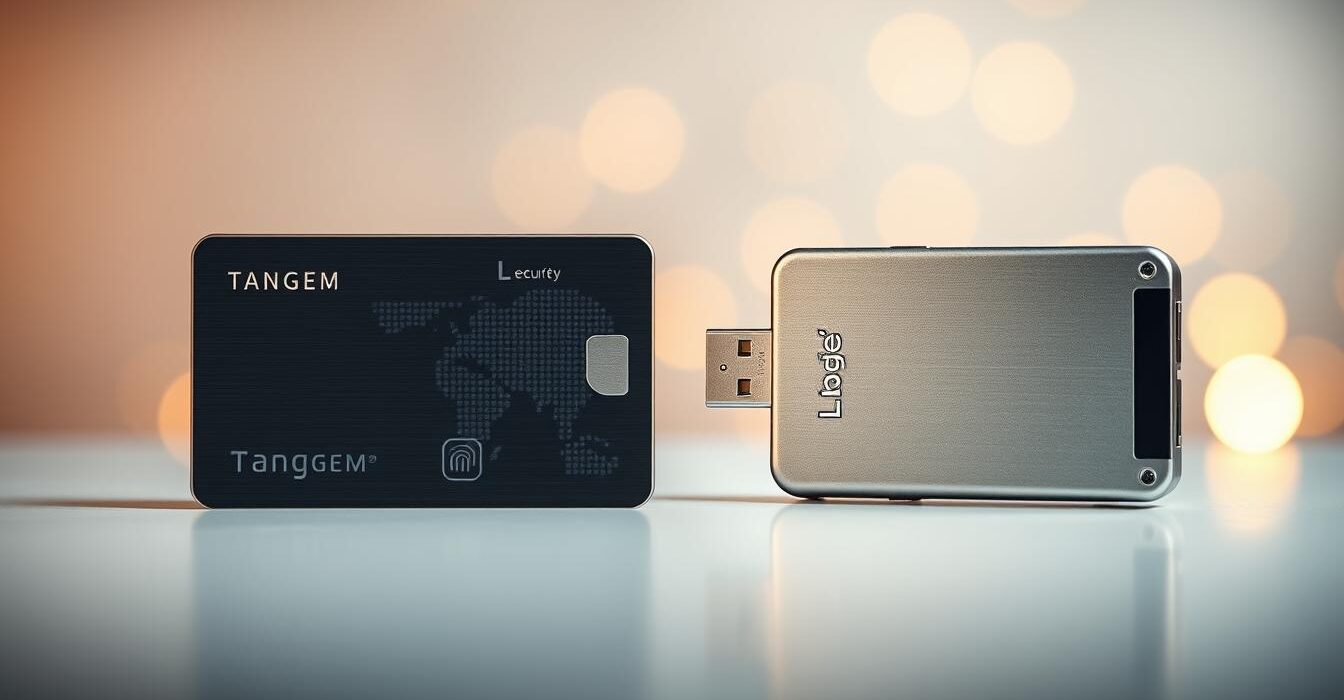
Tangem presents itself as a card. It’s thin, fits in your wallet, and operates through your smartphone. Ledger is a USB device that connects directly to your computer.
Two completely different form factors. Two different philosophies about what a hardware wallet should be.
This hardware wallet comparison isn’t about declaring a universal winner. The right choice depends on how you actually use crypto. Your answers shape everything.
Are you someone who trades frequently and needs quick access? Do you prefer maximum security with minimal setup? Are you moving large amounts occasionally?
I’ll walk you through the security architecture of each device. You’ll see their backup mechanisms, recovery options, and how they handle private keys. You’ll understand the price differences.
You’ll learn how each one performs with token swaps and conversions.
This tangem vs ledger analysis comes from hands-on experience, not marketing materials. Let’s dig into what actually matters for storing your digital assets.

Key Takeaways
- Tangem uses card-based technology while Ledger operates as a USB device, offering different portability and accessibility options
- Both devices store private keys offline in secure elements, protecting against online theft and exchange hacks
- Hardware wallet comparison shows Tangem excels in mobile-first workflows while Ledger dominates desktop security
- Tangem vs Ledger pricing differs significantly, with cards starting lower than USB models
- Each device supports different cryptocurrencies and networks with varying levels of integration
- Recovery and backup mechanisms work differently between the two platforms
- Token swap functionality varies between Tangem and Ledger ecosystems
Understanding Hardware Wallets for Cryptocurrency Storage
Getting into cryptocurrency means facing the wallet question. Should you keep digital assets on an exchange? Use a software wallet on your phone? Or invest in something more serious?
Understanding hot and cold storage changes how you protect your investments. Cryptocurrency hardware wallets have become the backbone of serious crypto wallet security.
Think of your cryptocurrency like cash. A hot wallet is like carrying money in your pocket—convenient but risky. A best cold storage wallet is like a safe deposit box—less convenient but protected.
What Makes Hardware Wallets Essential for Crypto Security
The numbers tell a stark story about online security risks. In 2022 alone, cryptocurrency exchange hacks resulted in losses exceeding $14 billion. Software wallets connected to the internet remain vulnerable to malware and phishing attacks.
Hardware wallets solve this problem by keeping your private keys offline. Your secret keys never touch a computer or phone. No online threat can access them directly.
- Exchange hacks target billions in assets yearly
- Phishing attacks trick users into revealing private keys
- Malware steals credentials from computer-based wallets
- Cryptocurrency hardware wallets eliminate these vectors entirely
Users with cryptocurrency hardware wallets experience dramatically lower theft rates. This isn’t marketing talk—it’s the practical reality of offline protection. Hardware wallets work against online threats.
How Cold Storage Protects Your Digital Assets
Cold storage operates on an air-gapped principle. Your cryptocurrency hardware wallets stay disconnected from the internet. The device signs transactions internally using your private key.
Your private keys remain offline and fully under your control. Nobody can access them without physically possessing your hardware wallet. Not a hacker, not a company, not a government agency.
| Storage Type | Internet Connection | Private Key Location | Theft Risk | Convenience |
| Exchange Account | Always Online | Company Servers | Very High | Excellent |
| Software Wallet | Always Online | Your Device | High | Good |
| Best Cold Storage Wallet | Offline | Hardware Device | Very Low | Moderate |
| Paper Wallet | Never Online | Physical Paper | Very Low | Low |
The best cold storage wallet approach works through a clean separation of concerns. Your device holds the private key and signs transactions. Your computer or phone never sees that key.
This architecture makes attacks exponentially harder. Attackers would need physical access to your hardware wallet itself.
Both Tangem and Ledger embrace this cold storage foundation. They implement it through different hardware designs and security approaches. Understanding this shared principle helps you appreciate what makes each solution distinctive.
Tangem Wallet Overview: Card-Based Security Innovation
The Tangem wallet takes a different approach to hardware wallet design. Instead of USB devices, Tangem uses NFC-enabled cards that look like credit cards. This innovative approach stores your cryptocurrency private keys offline.
Each card has a certified secure element chip built inside. This same technology protects passports and payment cards worldwide. The chip stores your private keys in an encrypted environment isolated from internet threats.
You simply tap the card to your smartphone using NFC technology. The communication happens in milliseconds. Your keys stay safe during the entire process.
One major advantage sets Tangem apart in the tangem card vs ledger nano debate. Cards come in sets of two or three. Each card contains identical keys.
This means you get built-in backup without managing seed phrases. Lose one card? Your other cards work perfectly. No need to write down recovery codes that people often store insecurely.
How Tangem Setup Works
Getting started takes just a few minutes. Download the Tangem app and scan your first card. Set up biometric authentication or a passcode.
The interface stays clean and straightforward. No overwhelming menus or confusing options appear.
Here’s what the setup process involves:
- Download the Tangem app on your NFC-enabled smartphone
- Scan your first card to initialize the wallet
- Create a security passcode or enable biometric authentication
- Receive backup card pairs automatically during creation
- Begin sending and receiving cryptocurrencies immediately
Supported Assets and Network Flexibility
Tangem supports an extensive range of cryptocurrencies across multiple blockchain networks. The wallet continues expanding its supported assets regularly. It addresses requests from the growing user community.
| Feature Category | Tangem Implementation | Real-World Impact |
| Form Factor | Credit card size with NFC chip | Highly portable, fits in your wallet easily |
| Backup System | Multiple cards with identical keys | No seed phrase management needed |
| Authentication | Biometric or PIN code | Quick access without compromising security |
| Device Requirement | NFC-enabled smartphone | Works with most modern phones |
| Transaction Speed | NFC tapping in milliseconds | Fast approval process for trading |
Practical Considerations for Users
The card-based design offers genuine benefits for portability and simplicity. You carry your wallet in your pocket like any credit card. There’s no USB port to wear out.
The NFC connection means you never plug anything into your phone. This reduces physical damage risks significantly.
The design trade-off involves device dependency. You need a smartphone with NFC capability for every transaction. Some users prefer seeing a physical screen on the wallet itself.
Tangem handles this through your phone’s app interface. It displays all transaction details before you tap the card to approve.
A tangem wallet review shows this approach eliminates the biggest pain point in crypto security. Traditional seed phrases remain one of the weakest links because people store them insecurely. Tangem’s multi-card backup system solves this problem elegantly.
This makes it worth serious consideration in the tangem card vs ledger nano decision.
Ledger Nano Features: The Industry Standard Explained
Ledger has shaped how most people think about cryptocurrency hardware wallets. The compact USB stick design is what you probably imagine. Ledger perfected this form factor that others now copy.
I’ve noticed that cryptocurrency hardware wallets from Ledger command significant market attention. There’s real substance behind their reputation. The Nano S Plus and Nano X represent the current mainstream offerings.
Understanding what makes them tick reveals why they’ve become the industry benchmark. The physical design itself tells part of the story. These devices fit in your pocket—about the size of a thumb drive.
A small screen and two buttons handle navigation. This simplicity masks sophisticated engineering underneath. You’re holding years of security refinement that’s become the standard.
Ledger’s Secure Element Technology
The real magic lives inside Ledger Nano features through their certified secure element chip. Ledger uses a CC EAL5+ certified chip. This security level gets deployed in government applications.
This isn’t marketing language; it’s an independent certification. The chip physically resists tampering and side-channel attacks. It defends against sophisticated assault vectors.
Here’s what this means in practical terms:
- Your private keys are generated inside the secure element and never leave it
- Every transaction gets verified on the device screen before approval
- Malware on your computer cannot intercept or alter transactions
- The two-button confirmation process adds a physical security layer
You physically confirm what happens with every transaction approval on your Ledger device. This protection against malware is crucial. Your computer might be compromised while your private keys stay locked away.
Supported Cryptocurrencies and Networks
Ledger’s support for digital assets is genuinely impressive. The ecosystem covers 5,500+ tokens across multiple blockchains. Their Ledger Live software manages everything.
Bitcoin, Ethereum, Solana, Cardano, Polkadot—the major networks are all there. Hundreds of altcoins get coverage as well.
The way ledger nano features handle storage deserves explanation. The Nano S Plus comes with limited onboard storage. You can’t install every app simultaneously.
You swap blockchain apps as needed without affecting your holdings. The Nano X adds Bluetooth connectivity and expanded storage. This lets you keep more apps active.
| Supported Blockchain | Token Count | Primary Assets |
| Bitcoin Network | 1 (BTC) | Bitcoin |
| Ethereum Network | 5,000+ | ETH, ERC-20 tokens |
| Solana Network | 200+ | SOL, SPL tokens |
| Cardano Network | 150+ | ADA, native tokens |
| Polygon Network | 3,000+ | MATIC, ERC-20 variants |
Ledger Live serves as the command center for cryptocurrency hardware wallets. The software handles portfolio tracking, app management, and transaction signing. The interface is functional, though the learning curve exists for new users.
Navigation feels deliberate rather than intuitive. Reliability matters more than flashiness though. Your assets need protection above all else.
Tangem vs Ledger: Direct Feature Comparison
Choosing between hardware wallets means deciding what matters most for your crypto security. Both devices keep your private keys offline effectively. They just take different approaches to solving the same problem.
The tangem card vs ledger nano comparison starts with physical design. Tangem cards measure 86mm by 54mm—credit card size exactly. They weigh almost nothing and slip into your wallet easily.
I’ve carried them for months without noticing they’re there. Ledger’s USB stick design takes up more pocket space. The Nano S Plus and Nano X are bulkier, needing a dedicated pouch or bag compartment.
Display functionality separates these devices clearly. Ledger built-in screens let you verify transactions on the device itself. Tangem uses your smartphone for verification through their app. The security gap here? Minimal if your phone isn’t compromised.
| Feature | Tangem Card | Ledger Nano S Plus | Ledger Nano X |
| Form Factor | Credit card (86x54x0.8mm) | USB stick (57.3×19.2×9.2mm) | USB stick (57.3×19.2×9.2mm) |
| Built-in Display | No (uses phone screen) | Yes (OLED) | Yes (OLED) |
| Backup Method | Multiple identical cards | 24-word recovery phrase | 24-word recovery phrase |
| Supported Assets | Growing (500+ tokens) | 5,500+ tokens | 5,500+ tokens |
| Waterproof | Yes | No | No |
| Setup Time | 5-10 minutes | 20-30 minutes | 20-30 minutes |
| Price Range | $50-70 (2-card set) | $79 | $149 |
Setup complexity matters if you want to secure your assets quickly. With Tangem, you scan the card and set a passcode. You’re done in minutes total.
Ledger requires more steps: initializing the device and writing down a 24-word seed phrase. You also install Ledger Live software and blockchain-specific apps for each cryptocurrency. This isn’t difficult, just more involved.
Backup and recovery introduce real differences between these wallets. Tangem gives you multiple cards with identical keys—no seed phrase to manage. Ledger uses the traditional 24-word recovery phrase approach.
Both work, but they handle disaster scenarios differently. Tangem cards are waterproof and nearly indestructible. Ledger devices are more fragile and need careful handling.
Cryptocurrency support varies between these two hardware wallets. Ledger supports 5,500+ tokens across major blockchains. Tangem’s support is growing but currently covers around 500 tokens.
If you’re trading Bitcoin, Ethereum, or mainstream altcoins, both handle this fine. For obscure or newer tokens, Ledger offers broader compatibility.
Price shapes the decision for many users. A two-card Tangem set runs $50-70. Ledger Nano S Plus costs $79.
The Nano X reaches $149 and adds Bluetooth connectivity for mobile use. Your budget and intended usage determine whether paying more makes sense.
- Choose Tangem for portability, simplicity, and wallet-friendly form factor
- Choose Ledger for display verification, broader token support, and established ecosystem
- Both provide equivalent security for storing private keys offline
- Your specific needs—not marketing hype—should drive your choice
The tangem vs ledger debate lacks a universal winner. Your priorities determine which hardware wallet comparison favors one device. Think about what you actually use daily.
Do you travel constantly? Does simplicity matter more than features? Will you hold obscure tokens? These answers guide you to the right tool.
Security Architecture: How Each Wallet Protects Your Private Keys
The real battle for crypto security happens at the chip level. Both Tangem and Ledger follow one key rule: your private keys never leave the device. That’s the baseline for any legitimate hardware wallet.
The difference lies in how they build their defense systems around this principle. The architecture these wallets use determines whether your crypto wallet security withstands sophisticated attacks. Think of it like comparing a fortress with one strong wall versus multiple defensive layers.
Offline Storage and Attack Prevention
Ledger uses a dual-chip design. Your private keys sit on a secure element certified at CC EAL5+, completely isolated from the main processor. Even if someone hacks the firmware, the secure element stays locked down.
Tangem takes a different approach with their Samsung S3D350A chip, which carries a higher certification at CC EAL6+. This means their secure element has been tested more rigorously against physical attacks. Both wallets resist side-channel attacks where attackers analyze power consumption or electromagnetic signals.
Here’s what matters practically:
- Neither wallet has experienced successful real-world hacks
- Both prevent keys from touching the internet
- Ledger’s design includes a screen and buttons, creating more potential entry points
- Tangem’s card design minimizes complexity, reducing attack surface area
The certification letters (EAL5+ and EAL6+) aren’t marketing fluff. They represent months of testing in laboratories where security experts attempt fault injection attacks. Your crypto wallet security depends on these safeguards working as designed.
Backup and Recovery Mechanisms
This is where the approaches diverge significantly. It’s worth thinking carefully about which method feels right for you.
Ledger uses seed phrases—twelve or twenty-four words that unlock your wallet if the device fails. It’s the industry standard. People write these phrases on paper and hide them in drawers, worrying about fire damage.
Some store them digitally, defeating the entire purpose. The system works, but it depends on you protecting a separate piece of information.
Tangem eliminated seed phrases entirely. Your backup IS purchasing multiple cards. Activating a Tangem card means it holds the same keys as your other cards.
Lose one card, you’ve got backups. Lose all your cards, your crypto becomes inaccessible—but that’s also true if you lose your Ledger AND your seed phrase simultaneously.
| Backup Method | Security Approach | Recovery Difficulty | Physical Risk |
| Ledger Seed Phrase | Information redundancy | Straightforward if you have the phrase | Paper vulnerability to damage or theft |
| Tangem Multi-Card | Physical redundancy | Automatic with backup cards | Requires keeping cards in separate locations |
Looking ahead, secure crypto storage solutions are moving toward biometric authentication and distributed key management. Both Tangem and Ledger are positioned to adapt. Future versions might combine what works best from each approach—the redundancy of multiple devices with biometric verification.
The uncomfortable truth? Neither system is perfect. Your crypto wallet security ultimately depends on your habits.
Ledger requires you to protect your seed phrase like your life depends on it. Tangem requires you to actually purchase and maintain multiple cards. Pick the one that matches how you actually behave, not how you wish you’d behave.
User Experience and Setup Process
Getting a hardware wallet running matters more than people realize. Security features don’t help if setup frustrates you into skipping important steps. I’ve tested both wallets from the ground up.
Setting up a Tangem wallet is refreshingly quick. You download the app on iOS or Android, open it, and tap “Scan card.” Hold your Tangem card near your phone’s NFC reader for 2-3 seconds.
Create an access code or enable biometric authentication. If you have backup cards, scan those too. The whole process takes about five minutes.
Once you’re done, the app immediately displays your wallet addresses across supported blockchains. This tangem wallet review shows how streamlined the card-based approach feels in practice.
Ledger setup demands more patience. Unbox the device, connect it via USB to your computer, and initialize it. You’ll choose a PIN code using the device’s two-button interface.
Write down your 24-word recovery phrase and triple-check it. Confirm the phrase on the device itself. Install Ledger Live software, reconnect your Ledger, then install blockchain apps for each cryptocurrency.
Budget 20-30 minutes minimum. Plan longer if you’re being appropriately careful with your seed phrase security.
Daily transactions reveal bigger differences between these wallets. With Tangem, you open the app, select your token, and tap “Send.” Enter the recipient address and amount, confirm the details, then tap your card to sign.
The whole approval takes seconds. The ledger nano features require a different workflow. Connect your device to a computer or phone and unlock it with your PIN.
Open Ledger Live and navigate to your cryptocurrency. Create the transaction, then physically verify and approve it using the device’s buttons. More steps, more time, more friction.
That friction isn’t entirely bad. It forces you to slow down and double-check what you’re actually signing. This prevents costly mistakes.
For someone making frequent transactions, Tangem’s speed advantage becomes noticeable. The app interface also matters. Tangem’s app feels modern and focused.
Ledger Live tries to pack everything into one platform—wallet management, token exchanges, staking, NFTs. It feels crowded because of it.
| Aspect | Tangem | Ledger Nano |
| Setup Time | 5 minutes | 20-30 minutes |
| Transaction Steps | 4-5 steps | 7-8 steps |
| Approval Speed | 2-3 seconds via NFC | 15-30 seconds with buttons |
| App Design | Clean and minimal | Feature-rich but complex |
| Mobile-First | Yes, NFC based | Limited on mobile (Nano X only) |
User experience shapes adoption. A tangem wallet review that ignores setup and daily-use reality misses what actually matters. You can read about security architecture all day.
But if the wallet frustrates you repeatedly, you’re more likely to make mistakes. Neither approach is wrong for every person.
Some users value the deliberate pace and button-based verification of Ledger Nano devices. Others appreciate Tangem’s speed and mobile convenience. Your preference depends on how often you transact and what device ecosystem you use.
Converting and Swapping Crypto with Hardware Wallets
Modern hardware wallets let you swap cryptocurrencies without using centralized exchanges. This feature matters for anyone managing multiple digital assets. People often overlook swap capability during bitcoin wallet comparison, yet it improves your daily workflow.
Both Tangem and Ledger offer this service. The experience differs in interface design and execution speed.
The swap feature removes friction from crypto portfolio management. You complete the entire process within your wallet app. This reduces exposure to exchange platforms and keeps private keys offline.
Using Tangem App for Token Swaps
The Tangem app makes token swapping straightforward and transparent. The process works like this:
- Open the Tangem app on your mobile device
- Navigate to the token page you want to exchange (for example, USDT)
- Tap the “Swap” button
- Enter the asset you want to receive (such as Solana or Bitcoin)
- Review the conversion rate, network fees, and provider fees
- Select your preferred provider from available options
- Confirm the swap details
- Authenticate using your access code or biometric identification
- Scan your Tangem card to approve the transaction
What makes this process valuable is rate aggregation. Tangem pulls conversion rates from multiple decentralized and centralized exchanges. You see the most competitive rates available.
You’re not locked into a single provider with unfavorable pricing. This transparency matters with larger amounts or frequent conversions.
The entire swap typically takes 30-60 seconds after you learn the interface. Network fees vary depending on the blockchain you’re using. Your cryptocurrency never leaves your possession during this process.
Exchange Integration and Conversion Rates
Ledger Live offers similar swap functionality through integrated partners including Changelly, Paraswap, and 1inch. The interface works adequately but feels less polished than Tangem’s app. You’re redirected to third-party services within Ledger Live rather than experiencing seamless in-app integration.
| Feature | Tangem Swap Experience | Ledger Swap Experience |
| Rate Aggregation | Displays multiple provider rates simultaneously | Shows competitive rates but less transparent |
| Interface Design | Streamlined and intuitive | Functional but redirects to third parties |
| Network Fees | Varies by blockchain (transparent display) | Varies by blockchain (transparent display) |
| Provider Fees | Typically 0.5-1% of transaction | Typically 0.5-1% of transaction |
| Transaction Speed | 30-60 seconds (once familiar) | Slightly longer due to redirects |
| Asset Control | Remains in your wallet throughout | Remains in your wallet throughout |
People who regularly rebalance portfolios benefit from built-in swap functionality. You avoid transferring funds to exchanges, reducing time spent and security risks. During bitcoin wallet comparison, consider how often you’ll use swaps.
Both platforms charge network fees plus provider service fees. The real difference lies in how clearly each platform presents costs. Interface ease matters when executing multiple swaps.
Price Comparison and Value for Money
Cost matters when choosing between cold storage wallets. You’re already investing in cryptocurrency, so security shouldn’t drain your budget. Many newcomers hesitate at checkout, wondering if these devices are worth the money.
Tangem pricing sits comfortably below most competitors. A 2-card set runs between $59-69, while a 3-card set costs around $99-109. That’s your complete purchase with no hidden fees or required accessories.
Your smartphone becomes the interface. The cards handle the heavy lifting of security.
Ledger positions itself at different price points. The Nano S Plus costs approximately $79, making it competitive with premium Tangem options. The Nano X jumps to around $149, reflecting its Bluetooth capability and expanded app storage.
The real cost creeps in through accessories. Want mobile functionality with the S Plus? Budget an extra $10-15 for a USB OTG adapter.
The optional Ledger Backup Pack adds another $99 if you want dedicated seed phrase storage.
Looking at tangem vs ledger from a total cost perspective reveals interesting patterns. Your upfront investment becomes a one-time security expense. This pays dividends across years of use.
| Wallet Model | Base Price | Additional Accessories | Total Average Cost | Cryptocurrency Support | Best For |
| Tangem 2-Card Set | $65 | None Required | $65 | 1,000+ | Budget-Conscious Users |
| Tangem 3-Card Set | $104 | None Required | $104 | 1,000+ | Enhanced Backup Strategy |
| Ledger Nano S Plus | $79 | USB OTG Adapter ($15) | $94 | 5,500+ | Desktop-Focused Users |
| Ledger Nano X | $149 | None Required | $149 | 5,500+ | Mobile & Desktop Users |
The value assessment shifts based on your needs. Tangem delivers excellent bang for your buck if you want simplicity and portability. You get military-grade security, multiple backup cards, and smartphone compatibility for under $70.
The best cold storage wallet selection depends on your priorities. Do you value cost or comprehensive altcoin support?
Ledger justifies its pricing through ecosystem breadth. The physical screen verification adds a security layer many users appreciate. Support for thousands of tokens and the Ledger Live platform creates a complete solution.
Consider this reality: both represent one-time security investments. Compared to potential losses from a compromised hot wallet, either option pays for itself. Preventing a single incident makes the investment worthwhile.
- Tangem offers the lowest entry point for secure storage
- Ledger Nano X provides the most features but highest initial cost
- No wallet requires expensive subscriptions or recurring fees
- Accessories can quietly increase your total spending with Ledger products
- Your choice reflects your usage patterns, not wallet superiority
Price tells only part of the story in tangem vs ledger comparison. Your specific needs shape the real value calculation. Do you need extensive altcoin support, prefer mobile access, or value maximum portability?
Both represent solid security investments that outlast multiple market cycles.
Conclusion
After working through this hardware wallet comparison, one thing stands out: neither Tangem nor Ledger is universally better. They solve different problems for different people. Tangem excels at simplicity and portability.
The card design feels natural in your pocket. The multi-card backup system removes the stress of managing seed phrases. That NFC tap-to-approve workflow beats clicking through screens.
Tangem shines for people holding Bitcoin and major altcoins who want secure crypto storage solutions without wrestling with complexity. Ledger wins on breadth and maturity. Its ecosystem supports hundreds of tokens.
The physical screen adds a verification layer that matters for serious traders. The Ledger Live platform, despite its quirks, delivers more features than Tangem’s app. Ledger works best for users holding diverse portfolios and wanting maximum flexibility in their secure crypto storage solutions.
Your choice depends on what matters most to you. Pick Tangem if you’re new to hardware wallets or hold mainly mainstream cryptocurrencies. Choose it if you value simplicity over features.
Tangem works great if you want something you carry daily. It’s perfect if you prefer physical backup cards over seed phrases.
Pick Ledger if your portfolio includes smaller altcoins. Choose it if you want the reassurance of a proven standard with extensive documentation. Ledger suits you if you trust a physical screen for verification.
It’s ideal if you’re comfortable with traditional seed phrase backups. Some users keep both wallets. They use Tangem for frequent transactions and accessible funds while reserving Ledger for long-term storage of diverse holdings.
This hardware wallet comparison reveals that both options beat keeping coins on exchanges or in hot wallets. Hardware wallet technology is moving toward friendlier user experiences. Tangem’s card approach and seed-phrase-free backup point one direction.
Expect more innovations in biometric authentication, social recovery options, and seamless multi-device syncing. Both Tangem and Ledger have the resources to adapt to these shifts.
The real takeaway matters more than any comparison: either wallet provides exponentially better security than exchange storage. Your best choice matches your specific needs, comfort level with technology, and actual use patterns. Pick based on your priorities.
“`html
# Tangem vs Ledger: Which Hardware Wallet Wins?
I’ve spent considerable time with both hardware wallets. I tested them in real-world scenarios and explored their performance beyond marketing materials. This straightforward comparison evolved into something more nuanced—a genuine exploration of two different approaches to cold storage security.
The choice between Tangem and Ledger isn’t just about features. It’s about trust, usability, and how you interact with your cryptocurrency daily. Both devices accomplish the same core mission—keeping your private keys offline and protected from internet-connected threats.
But they take remarkably different paths to get there.
Tangem represents an innovation I found genuinely refreshing: a card-based hardware wallet using NFC technology. This replaces the USB stick form factor that’s dominated the industry for years. Ledger has essentially defined what most people think of when they hear “hardware wallet.”
It’s the trusted, proven standard that’s been securing crypto holdings since 2014.
Why does this comparison matter? Exchange hacks, phishing attacks, and malware targeting software wallets continue to plague the industry. We’re talking about billions in losses over the past few years.
Hardware wallets have become genuinely essential, not optional. Choosing which one requires understanding what you’re actually getting with each approach.
I’ll break down the security architecture, user experience, price considerations, and swap functionality of both devices. I’ll share specific experiences from testing both wallets extensively. This includes setup processes, daily usage, transaction verification, and backup approaches.
By the end, you’ll have a clear picture of which wallet aligns with your priorities. There isn’t a universal winner here, which is the honest truth.
—
## Understanding Hardware Wallets for Cryptocurrency Storage
Let’s establish the foundation of what hardware wallets actually do. We need to understand why they’ve become essential for anyone serious about protecting their cryptocurrency holdings.
### What Makes Hardware Wallets Essential for Crypto Security
The vulnerability of hot wallets is staggering when you look at actual numbers. Hot wallets are software wallets connected to the internet. In 2022 alone, cryptocurrency exchanges and platforms suffered hacks resulting in over $14 billion in losses.
Phishing attacks targeting wallet users extracted hundreds of millions more. Malware designed specifically to intercept cryptocurrency transactions has become increasingly sophisticated.
These aren’t theoretical risks. They’re documented, recurring problems that have destroyed people’s financial security.
Here’s what makes a hot wallet dangerous: your private keys exist on an internet-connected device. That device can be compromised. A skilled attacker, malware running in the background, or software weakness creates a window of vulnerability.
Your keys can be stolen without you ever knowing. You might only discover this when you try to access your wallet and find everything gone.
Hardware wallets solve this fundamental problem by moving your private keys into an isolated, offline environment. The device keeps your keys in a secure element. This is a specialized chip designed specifically to resist hacking attempts, even physical attacks.
The transaction is created on your computer or phone. But the crucial step—signing the transaction with your private key—happens on the hardware wallet itself. It stays offline and protected.
The statistics are compelling. Users who store cryptocurrency on hardware wallets haven’t experienced the same breach rates. This isn’t because hardware wallet companies are necessarily smarter than exchanges.
It’s because the fundamental architecture is different. Your keys never leave the device. No amount of hacking skill can extract them if they’re stored properly.
### How Cold Storage Protects Your Digital Assets
Think of it this way: a hot wallet is like carrying cash in your pocket. It’s convenient—you can spend it whenever you want with minimal friction. But if you get pickpocketed, your money is gone.
A hardware wallet is more like a safe deposit box at a bank. It’s less convenient—you can’t instantly access your funds. But the security is exponentially better.
Here’s how the actual mechanics work: the device generates your private key locally, on the secure element. This key is never transmitted anywhere. It stays on the device, encrypted and protected by firmware that’s resistant to tampering.
On your computer or phone: You create a transaction. You specify the recipient address, the amount, and any fees. This transaction data is unsigned—it’s like writing a check without signing it.
On the hardware wallet: The transaction is transmitted to your device. The device displays what you’re about to sign, either on its own screen or your phone’s screen. You verify the details match what you intended.
You approve the transaction, using a PIN code, passphrase, or biometric authentication.
The signing happens locally: Your private key combines with the transaction data using cryptographic algorithms. This creates a digital signature. This signature proves you authorized this specific transaction.
The signed transaction returns: The device sends back the signed transaction. This can now be broadcast to the blockchain network. The private key itself never left the device.
No one could intercept it during this process because it never traveled across any network.
This air-gapped approach keeps the key offline until the moment of transaction. This fundamentally changes the security equation. Even if your computer is completely compromised by malware, your cryptocurrency can’t be stolen.
Even if your phone is stolen or someone breaks into your cloud storage, access requires the hardware wallet itself.
Both Tangem and Ledger use this cold storage principle. The way they implement it differs significantly. But the core concept—keeping your private keys offline and isolated—is the foundation of security both devices share.
—
## Tangem Wallet Overview: Card-Based Security Innovation
Tangem represents something genuinely different in the hardware wallet landscape. Rather than adopting the USB stick form factor, Tangem took a different approach. They created a card-based hardware wallet using NFC (Near Field Communication) technology.
It looks like a credit card, feels like a credit card, and fits in your wallet exactly like one. But it contains a secure element that functions as a complete hardware wallet.
The innovation here goes beyond just form factor. Tangem fundamentally rethought the backup and recovery approach. Traditional hardware wallets use a seed phrase: a 24-word recovery code.
You need to write down this phrase, store it securely, and never lose it. Lose that phrase, and you lose access to your cryptocurrency forever.
Tangem eliminated this pain point entirely.
Instead of one card with a seed phrase backup, Tangem typically sells multi-card sets. A 2-card set means both cards contain identical keys. A 3-card set gives you even more redundancy.
If you lose one card, you still have your backup. If you lose all your cards, your crypto is gone. But you can’t use a seed phrase recovery anyway at that point.
What you gain is the elimination of managing that 24-word phrase. Most people write it on paper, store it in a drawer, or photograph and upload it to cloud storage.
From personal experience, I set up my Tangem wallet in about five minutes. Download the Tangem app, hold the card to your smartphone’s NFC reader, set an access code or enable biometric authentication. Then scan your backup cards to link them.
The app is clean, modern, and doesn’t overwhelm you with options. Everything you actually need is there. Nothing is cluttering the interface.
The card itself is remarkably durable. The technology inside uses a certified secure element chip. This is the same type of chip used in passports, national ID cards, and payment cards.
Tangem uses a Samsung S3D350A chip with CC EAL6+ certification. This is actually higher than Ledger’s CC EAL5+ rating. The card is waterproof, can withstand normal wear and tear, and won’t degrade from being in your wallet.
The workflow is streamlined: Open the app, select the token you want to send, enter the recipient address and amount. Review the transaction details, then tap your card to your phone. The NFC approval takes about 2-3 seconds.
Your phone confirms that the card signed the transaction, and you’re done. The transaction is then broadcast to the blockchain.
Tangem supports a substantial range of cryptocurrencies—Bitcoin, Ethereum, most major altcoins, and many smaller tokens. The supported list has been expanding regularly. For anyone primarily holding mainstream cryptocurrencies or widely-recognized tokens, you won’t run into limitations.
The platform’s accessibility is genuine. If you have a smartphone with NFC capability, you can use Tangem immediately. This includes the vast majority of modern Android phones and iPhones since the iPhone 7.
The trade-off with Tangem’s design is worth acknowledging honestly: you lose the physical verification screen. You’re verifying transactions on your phone’s display, not a dedicated device screen. This creates a theoretical security vulnerability.
If your phone is compromised by malware, the malware could theoretically display false transaction details. In practice, this is an extremely rare attack vector. It requires malware that specifically targets that one user, installed on their device, at that precise moment.
But it’s not zero risk, unlike Ledger’s approach where you verify on an isolated device.
For users who prioritize portability, simplicity, and clean user experience, Tangem’s innovation makes substantial sense. You’re getting hardware wallet security in a form factor that actually fits naturally into daily life.
—
## Ledger Nano Features: The Industry Standard Explained
Ledger has been the reference point for hardware wallets since they released the Ledger Nano in 2014. Most people imagine something like the current Ledger Nano S Plus or Nano X. It’s a USB stick-sized device with a small screen and physical buttons for navigation.
The Nano S Plus costs around $79. The Nano X, which adds Bluetooth connectivity and larger storage, costs around $149. Both use the same secure element technology at their core.
But the differences matter depending on your use case.
### Ledger’s Secure Element Technology
Ledger uses a CC EAL5+ certified secure element. This is the same certification level used in government-grade secure documents and high-security applications. This certification means the chip has undergone rigorous independent testing against sophisticated attack vectors.
What does this actually protect against? The secure element is designed to resist several types of attacks.
Side-channel attacks: Attackers try to extract information by analyzing power consumption, timing variations, or electromagnetic emissions. The secure element is specifically hardened against these analysis techniques.
Fault injection attacks: Attackers use lasers, electromagnetic pulses, or other techniques to introduce errors during computation. The chip includes countermeasures against these approaches.
Physical tampering: The secure element has anti-tamper mechanisms that detect if someone is trying to open it physically. It protects against attempts to extract the key directly.
Software attacks: The chip is isolated from the general-purpose microcontroller that handles communication with your computer. Even if that microcontroller is compromised or running malicious code, it can’t access your private keys.
The Ledger architecture separates the secure element from the main processor. The secure element holds your keys. The main processor handles user interface and communication.
This compartmentalization means that compromising the device’s firmware, screen, or buttons doesn’t compromise your keys. Your private keys remain isolated in their own protected space.
In practice, this architecture provides the highest assurance that your keys are protected. The physical verification step means even malware on your connected computer can’t trick you. You’re verifying the actual transaction on a device that can’t be compromised.
### Supported Cryptocurrencies and Networks
Ledger’s major advantage is breadth. They claim support for 5,500+ tokens across multiple blockchains. Bitcoin, Ethereum, Solana, Polygon, Cardano, Polkadot, and basically every major blockchain network are included.
Plus thousands of smaller tokens and newer projects.
This extensive support is possible through Ledger Live, their companion software. You have access to a marketplace of blockchain apps. You can install the Bitcoin app, the Ethereum app, the Solana app, or any of hundreds of others.
The Nano S Plus has limited storage. It can hold about 3-4 blockchain apps simultaneously. But you can swap apps in and out without affecting your holdings.
Your cryptocurrencies remain accessible on the device even if you uninstall the app.
The Ledger Live software manages everything from wallet functionality to portfolio tracking, exchange integration, staking, and NFT viewing. It’s feature-rich, though the interface can feel cluttered compared to simpler alternatives. You’re getting a complete ecosystem, not just a wallet.
For someone holding an unusual or newly-launched cryptocurrency, Ledger support is almost guaranteed. For someone holding primarily Bitcoin, Ethereum, and a handful of major altcoins, both Tangem and Ledger work equally well.
The difference becomes significant when you hold 20+ different tokens across multiple blockchain networks.
—
## Tangem vs Ledger: Direct Feature Comparison
Let’s compare these devices directly across the factors that actually matter to users.
Form Factor and Portability: Tangem measures 86mm × 54mm × 0.8mm and weighs almost nothing—credit card dimensions and thickness. You literally carry it in your wallet like cash. Ledger Nano S Plus is about the size of a USB thumb drive, roughly 3″ long and 0.5″ wide.
The Nano X is slightly larger due to its battery. From personal experience, I’ve carried Tangem cards in my wallet for months without noticing them. Ledger requires dedicated pocket space or a bag.
Winner for portability: Tangem by a significant margin.
Physical Verification Screen: Ledger has a built-in OLED screen where you physically approve transactions. Tangem displays transaction details on your smartphone screen before you tap the card to approve. Both approaches verify what you’re authorizing, but the trust model differs.
Ledger’s screen is theoretically more secure because it’s isolated from internet connectivity. But Tangem’s approach is practical and the security difference is negligible if your phone isn’t compromised. Advantage: Ledger for absolute security assurance, Tangem for practical security combined with convenience.
Setup Complexity: Tangem’s setup is genuinely fast—download app, scan card, create access code, done. Maybe 5 minutes. Ledger’s setup is more involved: initialize the device, create a PIN using two-button navigation, write down your 24-word recovery phrase.
You need to be extremely careful here. Then verify the phrase on the device, install Ledger Live, install blockchain apps you need. Takes 20-30 minutes, longer if you’re being properly cautious.
Winner: Tangem.
Backup and Recovery: This is where the philosophies diverge substantially. Tangem uses physical redundancy—multiple cards with identical keys. Lose one, you have backups.
Ledger uses information redundancy—a 24-word recovery phrase that recreates your keys if the device is lost. Both approaches have trade-offs. Tangem’s multi-card approach eliminates seed phrase management anxiety but means you need to keep multiple physical objects safe.
Ledger’s seed phrase approach means you only need to keep one piece of paper safe. But it requires careful management of that paper. Winner: Depends on your preference for physical vs. informational backups.
Cryptocurrency Support: Ledger has substantially broader support with 5,500+ tokens across virtually all networks. Tangem supports Bitcoin, Ethereum, major altcoins, and an expanding list of tokens. But you’ll encounter limitations if you hold obscure altcoins or very new tokens.
For mainstream holdings: tie. For diverse portfolios: Ledger.
Price Point: Tangem 2-card set costs approximately $59-69. Ledger Nano S Plus costs approximately $79. Ledger Nano X costs approximately $149.
For basic security: Tangem is most economical. For comprehensive features: Ledger Nano S Plus offers better value than Nano X.
Durability: Tangem cards are waterproof, practically indestructible, survive being sat on, dropped, or